



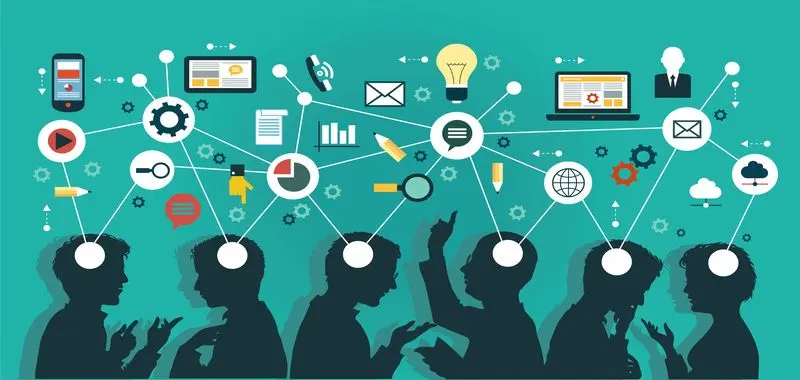
E-learning is a kind ofeducational technology that helps us deliver educational content through theinternet without making students sit in a physical classroom. It encompassesdownloadable e-books, audio content, video content, and structured courses withassignments and assessments. E-learning (e-education or distance learning)refers to the delivery of educational services online using web/ mobileapplications and internet access.
With the increasing need formobility in today’s world, it is very important to get everything digitalized.Following the same, you can say the books have been converted into digitalbooks which, you can read on your mobile phones, tablets, or computers.
The growing e-learning marketsize proves modern knowledge chasers prefer an online format to study when andwhere they want:

the most important attributeof E-learning is that it allows trainees to learn at any time of their ownchoice. There is no need to sit in boring classroom sessions where a trainer isallotted for only a specified amount of time. Below are some other attributesof E-learning that are reviewed with respect to a standard classroom trainingsession:
Reduction in cost oftraining – For classroom training sessions, it isrequired that you have a separate training room allocated for the purpose anddesignated trainers for one or more than one training module. The extra realestate and additional trainers on your payroll are not very cost-effective. Youmust pay recurring salaries and spend on the maintenance of training room infrastructure.On the contrary, an e-learning service provider can develop training contentfor you that can be used for training multiple batches. If the technology orconcept changes, it is possible to alter the content accordingly.
More immersive – Whenthe training content is voluminous, classroom training sessions can turn into aboring chore for the trainees. Such sessions may not be effective at all andall the efforts may go to waste. But, with eLearning, it is possible to usegamification tech along with Virtual Reality and Augmented Reality. As VR andAR use audio/video medium, the information is received via different humansenses, which leads to better retention of information.
Better evaluation oftrainees – The eLearning content can be devised in sucha way that at every juncture the employees are asked certain questions toevaluate their progress. The questions can be descriptive or multiple choices,depending on the requirement of the company. Constant evaluation of employeesallows managers to check their progress and plan re-trainings or othercorrective sessions to ensure that trainee progress is always up to theexpected levels.
Advantage –
1. Online LearningAccommodates Everyone’s Needs
The online method of learningis best suited for everyone. This digital revolution has led to remarkablechanges in how the content is accessed, consumed, discussed, and shared. Onlineeducational courses can be taken up by office goers and housewives too, at thetime that suits them. Depending on their availability and comfort, many peoplechoose to learn at weekends or evenings.
2. Lectures Can Be TakenAny Number Of Times
Unlike classroom teaching,with online learning, you can access the content an unlimited number of times.This is especially required at the time of revision when preparing for an exam.In the traditional form of learning, if you can not attend the lecture, then youhave to prepare for that topic on your own; in eLearning, you can attend thelectures whenever you want with ease.
3. Offers Access ToUpdated Content
A prime benefit of learningonline is that it makes sure that you are in synchronization with modernlearners. This enables the learner to access updated content whenever they wantit.
4. Quick Delivery ofLessons
eLearning is a way to providequick delivery of lessons. As compared to the traditional classroom teachingmethod, this mode has relatively quick delivery cycles. This indicates that thetime required to learn is reduced to 25%-60% of what is required in traditionallearning. There are some of the reasons why the learning time is reduced byeLearning:
Lessons start quickly andwrapped up in a single learning session. This enables training programs toeasily roll out within a few weeks, or sometimes even days. Learners can definetheir own speed of learning instead of following the speed of the whole group.Saves time as a student does not need to travel to the training venue. You canlearn at the comfort of your own place. Students can choose to study specificand relevant areas of the learning material without focusing on each area. Forexample, they can skip certain areas they do not want to learn.
5. Scalability
eLearning helps in creatingand communicating new training, policies, concepts, and ideas. Whether it isfor formal education or entertainment, eLearning is very quick way of learning!
6. Consistency
eLearning enables educators toget a higher degree of coverage to communicate the message in a consistent wayfor their target audience. This ensures that all learners receive the same typeof training with this learning mode.
7. Reduced Costs
eLearning is cost-effective ascompared to traditional forms of learning. The reason for this price reductionis because learning through this mode happens quickly and easily. A lot oftraining time is reduced with respect to trainers, travel, course materials,and accommodation.
This cost-effectiveness alsohelps in enhancing the profitability of an organization. Also, when you arestudying at your own place, you are relieved from paying for travel expenses(e.g. accommodation) when training happens in another city/state and/orexternal learning materials.
8. Effectiveness
eLearning has a positiveinfluence on an organization’s profitability. It makes it easy to grasp thecontent and digest it: It results in improved scores on certifications, tests,or other types of evaluation. The higher number of students who achieve the ‘pass’ ormastery’ level. Enhanced ability to learn and implement the new processes orknowledge at the workplace. Help in retaining information for a longer time.
9. Less Impact on Environment
As eLearning is a paperlessway of learning, it protects the environment to a lot of extents. As per a studydone on eLearning courses, it has been found that distance-based learningprograms consumed around 90% less power and generated 85% less amount of CO2emissions as compared to traditional campus-based educational courses. WitheLearning, there is no need to cut trees for obtaining a paper. Thus, eLearningis a highly eco-friendly way of learning.
Disadvantages:
1. Technology dependent:
The delivery of eLearning courses depends on technology.Inadequacy of required infrastructure such as computers, high internetbandwidth, and also lack of relevant technical skills in learners would greatlyhamper the success of an eLearning course.
2. Lackof motivation:
Learners may not be motivated to take a course since theyare in isolation and have flexibility. It requires a high level ofself-discipline and self-motivation from learners.
3. Lackof help/training support:
due to the absence of an instructor who can solve learners’queries, explain in detail topics that are not understood, analyze learners\'performance and provide detailed feedback
4. Lackof human touch:
since there is no direct interaction with the instructor orfellow learners during the learning process.
5. Inflexible:
It is not possible to alter the course in real-time basedon learners’ reactions and comfort
6. Start-upcost:
involved in designing, developing,and deploying a course.
Technologies and sciencegrowing and changing so fast, we just can’t afford to spend 5 years in collegelearning methods that will no longer be up to date or even relevant once we areout. We need to invest in shorter continuous education programs, mainly poweredthrough E-learning. It also empowers kids and adults to take control andaccountability for their education level. Training on the go accommodates a lotof people and in-class training will always limit the accessibility to expertise and knowledge.









No comments yet. Be the first to comment!