



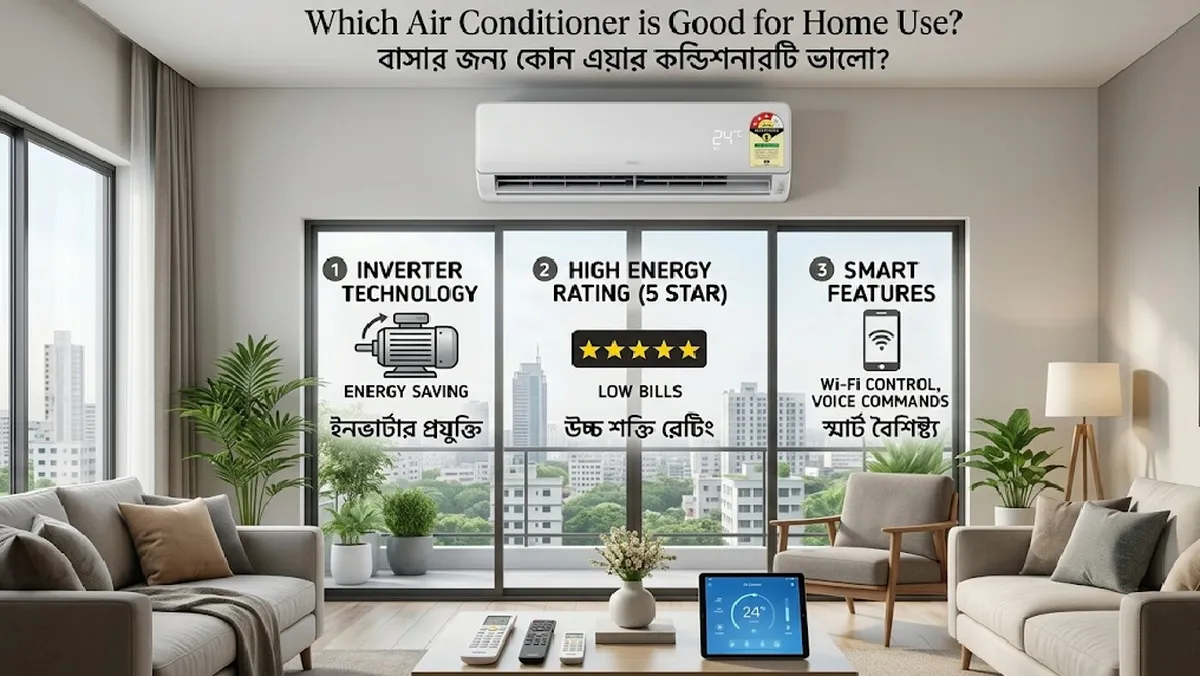
In the intense heat of summer, an air conditioner or AC is no longer a luxury but has become a necessity. In the weather of Bangladesh, when the temperature exceeds 35-40 degrees Celsius, having an AC at home means a guarantee of comfort and convenience. But numerous brands and models of AC are available in the market. Which one is suitable for your home, how many tons of AC will be needed, which type of AC will work better - finding the answers to these questions can be difficult. Through this writing, you can easily find out how to choose the right AC for your home.
What you need to know before buying an AC
Buying an AC is a long-term investment. A good quality Air Conditioner can last up to 10-15 years. Therefore, one should buy, keeping some important things in mind without taking random decisions. First, you need to know the size of your room, how many people live there, how much sunlight falls, and what your budget is. Understanding these factors will make it easier to select the right AC.
Selecting tonnage based on room size
The biggest mistake when buying an AC is in tonnage selection. Many think a higher tonnage AC means better cooling. But this is a completely wrong idea. Buying an AC with a higher tonnage than the room size will increase electricity consumption but will not provide good cooling. Again, buying a low-tonnage AC will not cool the room properly and the AC will always run under pressure, leading to early damage. Generally, a 1-ton AC is needed for a 100 square foot room. If your room is 100-130 square feet, then a 1-ton AC is sufficient. For a 130-180 square foot room, a 1.5-ton AC will work well. And for a large 180-250 square foot room or hall, a 2-ton AC is required. However, just looking at the size is not enough; one must also calculate how many people stay in the room, whether sunlight falls directly, whether there is a computer or other electronic devices, etc. If direct sunlight falls on the room, it is better to take half a ton more.
Split AC vs. Floor Standing AC
Basically, two types of AC are most commonly seen in the market, such as split AC and floor standing or cassette AC. Split AC is the most popular and suitable for homes. In a split AC, one unit is fixed on the wall inside the room and the other unit is kept outside. This results in less noise, looks beautiful, and takes up less space in the room. On the other hand, window AC have now become almost obsolete. They make more noise and installation is complex. However, the price is somewhat lower. Floor standing AC is usually used for offices or large halls. For a regular bedroom, a split AC is the best choice.
Inverter AC vs. Non-Inverter AC
Another big decision when buying an AC is whether to get an inverter or non-inverter. In terms of price, non-inverter ACs are cheaper, but electricity consumption is much higher. After starting, a non-inverter AC runs at full capacity and turns off when the room is cold. It starts again when it gets hot. This frequent on-off cycle consumes more electricity and harms the compressor. Inverter Air Conditioners are very smart. It automatically reduces or increases speed according to the room temperature. When the room is cold, it does not stop but continues to run at low power. As a result, electricity consumption decreases by up to 40-60%. Although it may seem expensive at first, the savings in the electricity bill recover this extra money within 2-3 years. Moreover, inverter AC provide more even cooling and make less noise. Therefore, if the budget is a bit higher then you can check inverter AC price list from Bdstall.
Energy Rating and Electricity Consumption
When buying an AC, check the energy rating label very carefully. Government-approved energy rating stickers are attached to the AC. This rating is from 1 star to 5 stars. 5 stars means the lowest electricity consumption and 1 star means the highest electricity consumption.
Many people buy cheap AC listening to shopkeepers which have a low energy rating. But later when electricity bills of thousands of taka come every month, they realize the mistake. Remember, a 1.5-ton non-inverter AC can consume 3,000-4,500 taka of electricity per month. On the other hand, a 5-star rating Air Conditioner with the same use will cost 1,500-2,000 taka. It will save 20,000-30,000 taka per year. So spend a bit more at first and buy an AC with a good rating.
Brand Selection and Warranty
Many of AC brands are available in Bangladesh like Daikin, Mitsubishi, Panasonic have good quality but high prices. Korean brands like Samsung, LG provide good quality at a medium price. Chinese brands like, Gree, Media, Chigo are cheap but there are mixed experiences with quality and service. Local brand Walton is budget-friendly and service is easy to get.
Whatever the brand, always buy from an authorized dealer or showroom. Check the warranty card carefully. Usually, an AC has 1 year parts and service warranty and the compressor has a 5-year warranty. Some companies offer up to 10 years of compressor warranty. This is a big advantage because the compressor is the heart of the AC; if it fails, the repair cost is very high.
Installation and Servicing
AC performance largely depends on proper installation. Have it installed by the company's own technicians. The indoor unit should be installed in such a way that air spreads throughout the room. The outdoor unit should be kept in a shaded place with good air circulation. Care must be taken so that gas leakage does not occur. Regular servicing is very important. Clean the filter once every 3-4 months. Have professional servicing done at least once a year. Check the gas and refill if necessary. This will maintain AC performance and increase its lifespan. Many people buy an AC and do not do any servicing for years. As a result, dust accumulates, performance decreases, and electricity consumption increases.
Additional Features and Smart Functions
Nowadays AC have many smart features. If there is Wi-Fi connectivity, the AC can be turned on or off from a mobile app. You can cool the room before returning from the office. A sleep mode automatically adjusts the temperature at night, so there is no fear of catching a cold and electricity is also saved. If there is a turbo mode or fast cooling feature, you can cool the room quickly in extreme heat. A dehumidifier function removes dampness from the room during monsoon. An air purifier filter cleans the air by removing dust and bacteria. However, the price is also higher if these features are more. Choose features according to your needs.
Budget Recommendations
If your budget is very limited and you want a 1-to AC within 32,000-40,000 taka, then you can look at non-inverter AC from Gree, Chigo, or Walton brands. However, keep in mind that the electricity bill will be higher.
To buy a 1.5 ton AC within a medium budget of 50,000-80,000 taka, inverter AC from LG, Samsung, and Walton are good options. These are electricity-saving and durable in the long run.
If the budget is good, 1,00,000-1,50,000 taka, then you can take 5-star inverter AC from Daikin, Mitsubishi, or Panasonic. These are of the best quality, consume the least electricity, and will last for 15-20 years.
Conclusion
Choosing the right AC for your home is not a difficult task at all if you know some basic things. Select the tonnage according to the room size, choose an inverter AC, check for an energy rating of 4 or 5 stars before buying, and pick products from a good brand with reliable service support. Ensure proper installation and regular servicing. Remember, buying an AC is not just about purchasing a machine; it is a long-term investment for your family's comfort and health. Therefore, do not rush and buy after thorough verification. If necessary, visit various showrooms to compare prices and features. Read reviews online. Then you can be sure that you have bought the right AC that will provide relief from the heat to your family for many years to come.







No comments yet. Be the first to comment!