


Agriculture & AI · May 2026
Will AI Replace Traditional Farmers
in the Future?
May 30, 2026 · 9 min read
I have been thinking about this question for a while now. Not in an abstract, philosophical way — but because I am watching it unfold in real time. Across Asia, Africa, and South America, the fields are changing. The tools are different. And the farmers who have worked the same land for generations are being asked to adapt faster than any generation before them.
The headline answer is no — AI will not replace traditional farmers the way a machine replaces a bolt. But the longer answer is more uncomfortable, and more interesting.
"AI will not replace the farmer. But a farmer who uses AI will replace the farmer who does not."
Where We Actually Are in 2026
Let us skip the hype and look at what is actually deployed in fields right now, not what is being demoed at conferences.
Autonomous drone spraying is no longer experimental. In parts of India, Vietnam, and Brazil, mid-scale farms are running fleets of drones that map crop health using multispectral imaging, identify diseased patches with computer vision models, and apply pesticide only where needed — reducing chemical use by 30 to 60 percent compared to blanket spraying. The cost of entry has dropped enough that a cooperative of smallholders can afford to share a single drone unit.
Soil sensors paired with ML prediction models are now a standard offering from several agricultural input companies. A farmer plugs a sensor network into their field, uploads the data to a cloud platform, and gets irrigation schedules, fertilizer recommendations, and yield forecasts. This is not futurism. This is a subscription service you can buy today.
Robotic harvesters are the piece that gets the most dramatic coverage, and they are genuinely impressive. Strawberry-picking robots in Japan and the UK can harvest 24 hours a day without fatigue. Tomato-harvesting arms in Dutch greenhouses outperform human pickers on speed. But — and this matters — these deployments are almost entirely in controlled, high-value, high-margin environments. Open-field staple crops like rice, wheat, and cassava? The robots are still struggling with the unstructured terrain, unpredictable weather, and the sheer variety of growth patterns.
$25B
Global AI in agriculture market value, 2026
40%
Reduction in water use via precision irrigation AI
570M
Smallholder farms worldwide still working manually
The 570 Million Problem
Here is the tension that gets lost in most technology coverage. The global conversation about AI in agriculture is largely being written by and for the 10 percent of the farming world that has reliable electricity, smartphones, and internet access. The other 570 million smallholder farms — concentrated in sub-Saharan Africa, South Asia, and Southeast Asia — are barely part of that conversation.
In Bangladesh alone, over 16 million farming households work plots averaging less than 0.6 hectares. For these farmers, the immediate threat is not an AI robot taking their job. It is erratic monsoon seasons, rising fertilizer costs, and a crop market that keeps them at the edge of subsistence. AI tools designed for commercial farms in California do not solve that problem. And most of the investment currently flowing into agri-AI is not designed with those farmers in mind.
That said, there are genuine bright spots. Low-cost soil testing apps that use a phone camera and ML analysis are reaching rural farmers in India and Ethiopia. WhatsApp-based advisory bots — trained on local crop knowledge — are giving real-time guidance in local languages. These are unglamorous applications but they are the ones actually reducing the knowledge gap for farmers who have never had access to an agronomist.
What Is Actually Being Replaced
Not the farmer. The inefficiency.
Over-irrigation is being replaced by sensor-driven scheduling. Guesswork fertilizer application is being replaced by soil health models. Manual pest scouting — which a skilled farmer once walked kilometers to perform — is being replaced by drone imaging that covers the same area in 20 minutes.
Labour displacement is real but narrow. It is happening most visibly in harvest-intensive, high-value crops where manual labour was already expensive and scarce. In regions where labour is abundant and cheap, the economics of robotic replacement simply do not work yet. The machine is not cheaper than the person in those markets — not in 2026.
The real shift is in skill, not survival. The farmer of 2030 will not need to know less — they will need to know differently. Understanding how to read a soil report, operate a drone, interpret a yield forecast model, or flag when an AI recommendation looks wrong. Farming knowledge is not disappearing. It is being translated.
Why I Am Paying Attention to This
I am a software engineer. My work lives in terminals, APIs, and databases. But I grew up watching family members farm. And I am deeply aware that the technology world I work in, and the agricultural world that feeds us, are on a collision course — one that has not been properly mediated yet.
This intersection — where Python models meet paddy fields, where computer vision meets crop disease, where LLMs get trained on agronomic knowledge — is something I have started building toward, alongside everything else I do at tahamidurtaief.com. Not because it is trending, but because it is a genuinely unsolved problem with real consequences for real people.
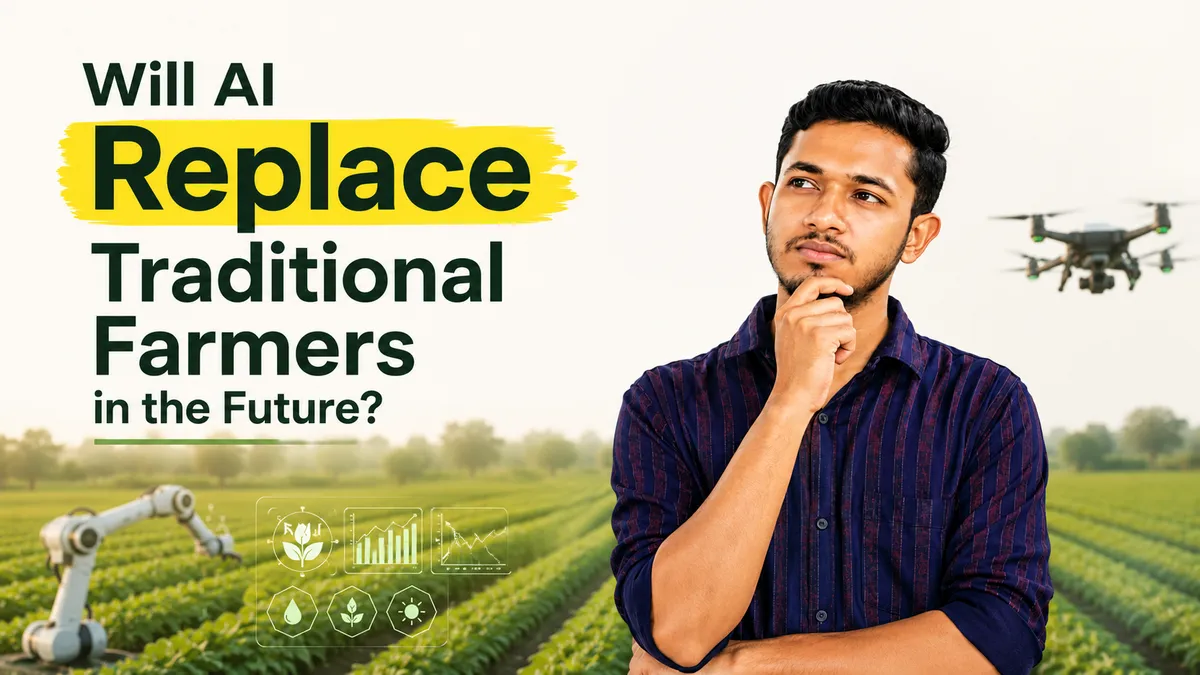
The farmers in the image above are not naive. They know drones are coming. They know something is changing. The question they are asking is not "will AI take my job?" It is "will anyone build something that actually helps me, or are they just building it for someone else?"
That is the question worth answering.
The Honest Forecast
AI will not replace traditional farmers in the next decade in any absolute sense. The technology is not there yet for unstructured, smallholder-scale, open-field agriculture. The economics are not there. The infrastructure is not there.
What will happen — and what is already happening — is a widening gap. Farmers who adopt AI-assisted tools will produce more, waste less, and earn more. Farmers who cannot access or afford those tools will fall further behind. The danger is not mass displacement by robots. The danger is a two-tier farming world where the benefits of precision agriculture compound for the already-resourced, and the rest are left with the same problems but in a more volatile climate.
That outcome is not inevitable. But it requires intentional work from the people building these systems — to think about who they are building for, not just what they are building.
If this made you think differently about AI and agriculture — share it with someone who works in either field. And follow along as I keep digging into where technology and the real world actually meet.
About — Tahamidur Taief
Software engineer, educator, and writer exploring where technology meets the real world. Known online as Taief and Code with Taief — writing about Python, Django, AI systems, and the broader questions that come with building technology.






Alhaz Hosen
4 months, ago❤️❤️❤️