



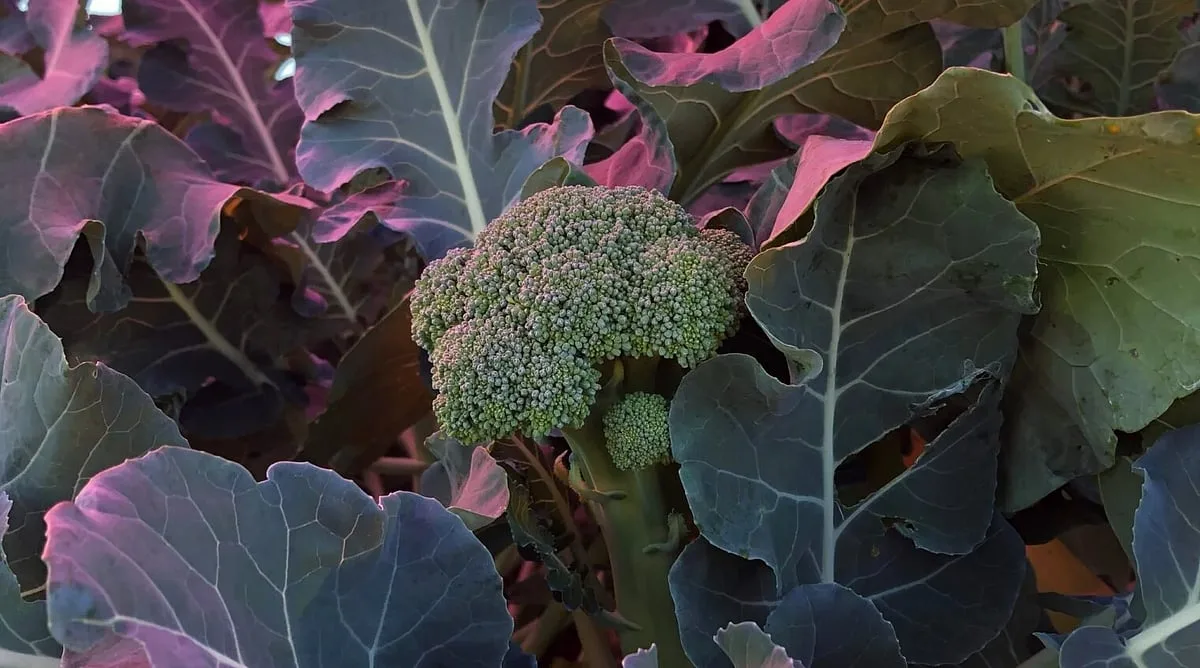
A team of Swedish researchers is working on a way to grow crops and generate electricity from solar panels on the same piece of land at the same time. In a study published in the journal Cell Reports Physical Science, researcher Silvia Ma Lu of Sweden's Mälardalen University and her team reported building prototypes of partially transparent, magenta-colored solar panels. These special panels allow the red and blue light wavelengths that plants need to reach the crops below, while also contributing to solar electricity generation.
According to the researchers, plants mainly use the red and blue parts of light to produce energy. Building on that idea, they developed magenta solar panels that let the light plants require pass through while still generating electricity. The team tested the technology's effectiveness by growing broccoli. They cultivated broccoli in three separate plots of 20 square meters each — one in normal sunlight and the other two beneath magenta solar panels with 50 percent and 70 percent transparency.
The experiment showed that broccoli yields under the two differently transparent panels were nearly the same. Although the broccoli grown under the panels took 25 days longer than usual to mature, the plants grew well despite receiving less light. Light efficiency was found to be 4.5 times higher under the 50 percent transparent panels and 2.8 times higher under the 70 percent transparent panels. Because opaque cadmium telluride strips are embedded in the panels' glass, light is able to pass through between them.
The research does have some limitations. The magenta panels were originally designed mainly for the aesthetic design of buildings, and they were used in this study as they are. In addition, although the panels' filter blocks green light, not all of that energy can be collected by the solar cells.
Commenting on the findings, Romesh Raydu, a researcher at Victoria University of Wellington in New Zealand, said these magenta panels generate less electricity per hectare than conventional solar panels. Whether the additional broccoli yield can make up for the shortfall in generated electricity will require research on a larger scale. However, the technology could already be used effectively on small community gardens or greenhouse rooftops.
Source: Science Alert






No comments yet. Be the first to comment!