
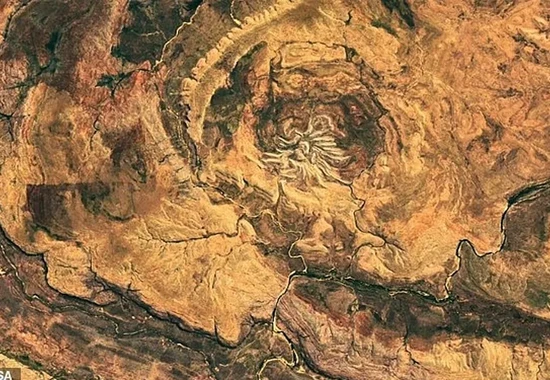

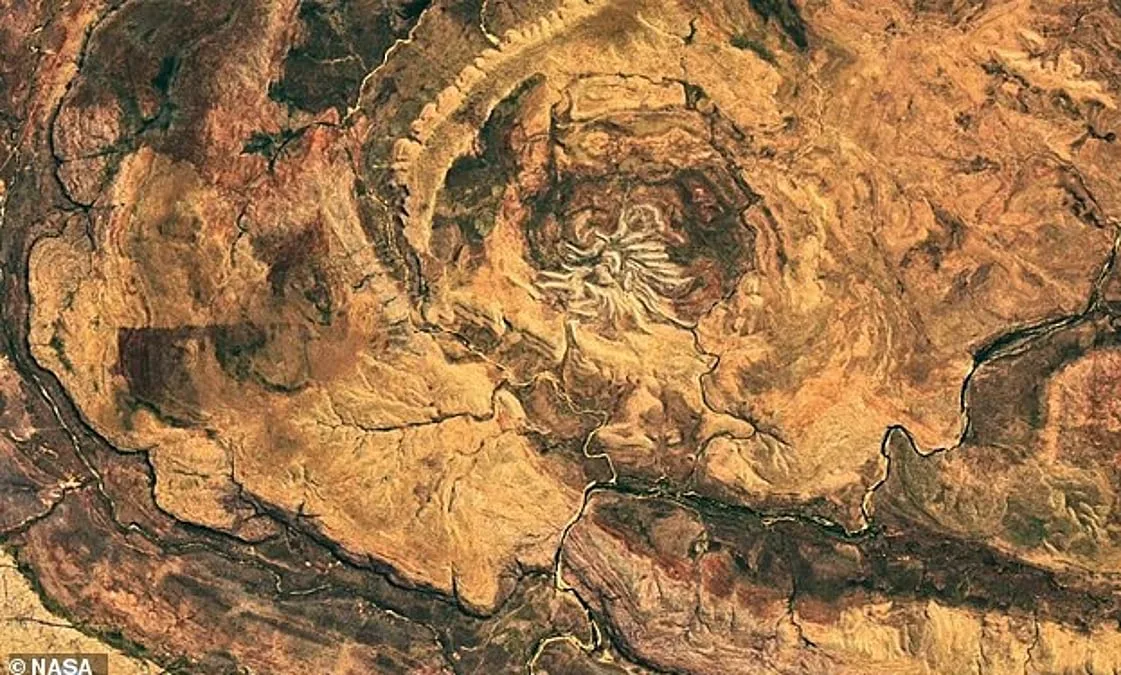
NASA has released satellite images of a huge, oddly shaped crater hidden in Australia's desert. The image was captured by NASA's Landsat 9 satellite as it passed over the Kimberley region of Western Australia. The crater, whose unusual form resembles a foot, has been named the 'Spider Crater'. Because the area is so remote, the crater's full extent is only clearly visible from the sky.
By studying high-resolution satellite images and mineral analysis, scientists have concluded that the Spider Crater is the site of an ancient meteorite impact. According to the researchers, the strange feature is essentially an impact scar that took on its spider-like appearance after billions of years of erosion. The oval crater spans an area of about 8 by 7 miles, while the spider-like structure at its centre is roughly 2.5 miles across. The discovery is expected to play an important role in understanding Earth's geological history and the effects of ancient cosmic impacts.
Scientists now understand what created the Spider Crater, but it is not clear exactly how many billions of years ago it formed. The impact is estimated to have occurred between 600 and 900 million years ago. At the centre of the crater, researchers have found a special kind of fracture known as shatter cones, a feature that forms only when intense shockwaves pass through rock.
Chris Kirkland, the lead author of the research, said the impact at the North Pole Dome created a long-lasting system of fractures. On the early Earth, processes of this kind may have altered minerals and reshaped the environment for microbial life by influencing the chemical exchange between rock and the primordial oceans. These impacts also caused zircon minerals to partially re-crystallise under intense heat in ancient times.
This article was adapted from a report originally published by Prothom Alo. Republished by TechLife Team.





No comments yet. Be the first to comment!