


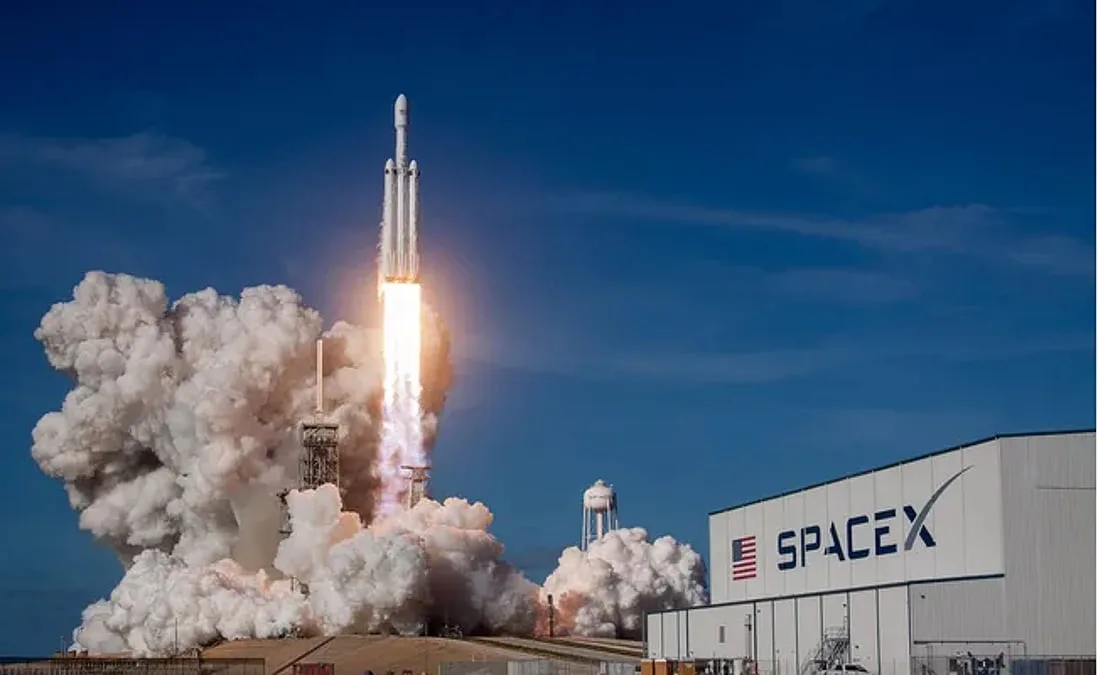
Reusable rocket and satellite launch technology is driving a quiet revolution in space research. By making rocket boosters reusable, this technology is making space travel simpler and more affordable. NASA's next-generation Roman Space Telescope was successfully sent into space on 30 August aboard a SpaceX Falcon Heavy rocket. After finishing its mission, the rocket's boosters returned safely to Earth.
The Falcon Heavy — popularly known as the "rocket taxi" — stands about 230 feet tall and can carry roughly 141,000 pounds of payload into low Earth orbit. Spectators gathered at NASA's Kennedy Space Center watched the boosters' flawless landing live. Of the boosters used in this mission, one touched down at Landing Zone Two and the other at Landing Zone. One of the boosters flew its first mission, while the other was on its third. Watching the Falcon Heavy's components return intact to Earth after launch has captivated science enthusiasts.
Built by SpaceX in a joint effort with NASA, the rocket taxi has made space travel more regular and convenient. The rocket taxi is essentially a commercial transport system that combines the Crew Dragon spacecraft with the Falcon 9 rocket. Its main purpose is to carry NASA and international astronauts safely to and from the space station. The booster flown in the first phase has already landed successfully on Earth.
Toward the end of 2020, the rocket taxi made history by enabling the first private human spaceflight. This commercial flight is playing a major role in bringing down the cost of space research. The successful application of reusable rocket technology has made space science more economical, and leading scientists around the world have praised the initiative.
Source: Space.com





No comments yet. Be the first to comment!